Deliberate Practice Reorders Risk Tolerance at 2-to-1 Skill Ratios
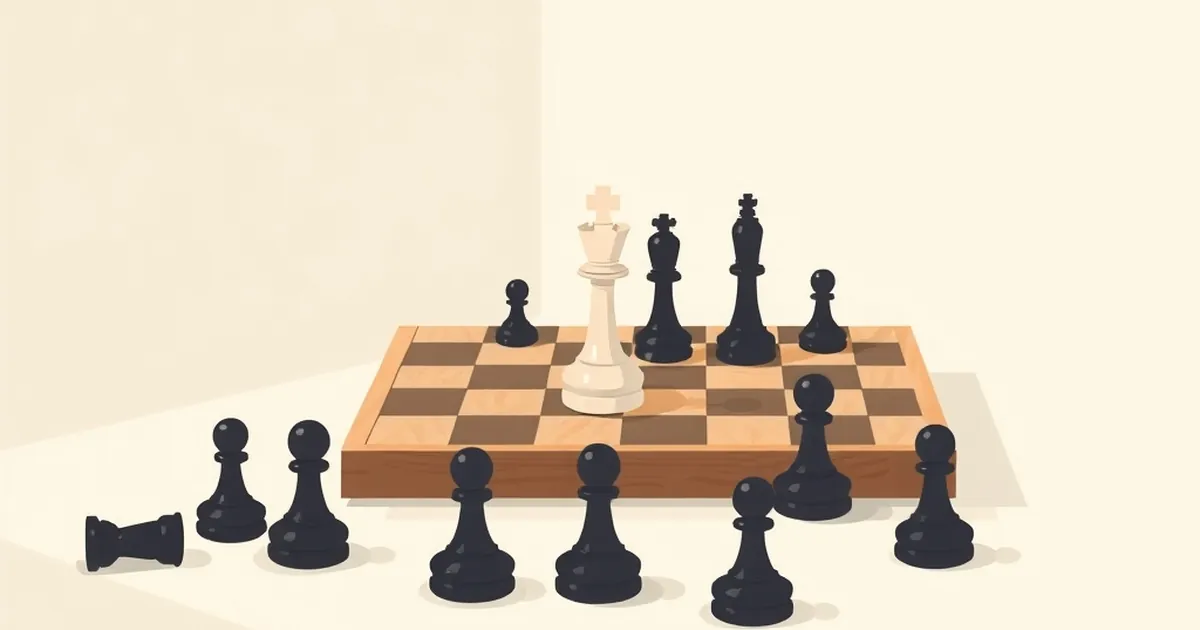
Why do experts in some domains take risks that look reckless to outsiders, while experts in others become almost pathologically cautious? The question isn't about courage or temperament. It's about how deliberate practice reshapes the boundary between a gamble and a calculation. When skill and challenge are matched at roughly a two-to-one ratio — where your developed ability is about twice the demand of the task — something shifts in how you read uncertainty itself.
The Arithmetic of a Fair Bet
Ericsson's foundational work on deliberate practice describes a specific condition: tasks must sit just beyond current ability, with immediate feedback and repetition. What's often overlooked is that this condition has a quantitative shape. When skill exceeds task demand by a wide margin, the task is boring. When demand exceeds skill by a wide margin, it's overwhelming. The productive band is narrow, and within it, the ratio of developed competence to situational difficulty hovers somewhere near two to one.
At that ratio, the probability of success on any single attempt is high but not certain — often in the range of 70 to 85 percent. This matters because it places the practitioner in a peculiar psychological position. They are winning often enough to stay engaged, but losing often enough that the outcome is genuinely uncertain. Kahneman and Tversky's work on loss aversion tells us that losses loom roughly twice as large as equivalent gains. A person operating at a two-to-one skill ratio is, in effect, taking repeated small bets where the downside is emotionally amplified but the base rate favors them. Over hundreds of repetitions, the practitioner accumulates something that looks like evidence: the bet is worth taking.
What Repetition Does to the Nervous System
Variable-Ratio Reinforcement and the Expert's Reframe
Skinner's variable-ratio schedules produce the most persistent behavior of any reinforcement pattern — not because the reward is large, but because its timing is unpredictable. Slot machines exploit this. So does deliberate practice. The difference is what the practitioner does with the unpredictability.
In a well-designed practice regime, the unpredictability is bounded. You know the task is hard. You know the feedback loop is tight. You know that failure carries information rather than cost. This is the crucial distinction: the same variable-ratio structure that produces compulsive behavior in one context produces calibrated risk tolerance in another. The variable isn't the schedule. It's whether the person has been trained to extract signal from the variance.
The Two-to-One Ratio as a Training Threshold
Consider chess. A player who consistently defeats opponents rated roughly 200 points below them is not improving — they're consolidating. A player who consistently loses to opponents 200 points above them is not learning efficiently either; the feedback is too noisy. The productive zone is narrower, and it maps onto a skill-to-challenge ratio where the player wins perhaps three out of four games. At that ratio, they encounter enough resistance to force adaptation but enough success to maintain a coherent model of what works.
The same structure appears in music. A pianist practicing a passage at 75 percent of their maximum tempo is working at roughly the two-to-one ratio. Fast enough to be challenging, slow enough to be accurate. The error rate is low but nonzero. Over time, the pianist's tolerance for the discomfort of near-miss — the note that almost landed, the phrase that almost cohered — becomes a trained response rather than an aversive one.
Risk Tolerance as a Reordered Priors Problem
Here's where the behavioral psychology gets interesting. Loss aversion is not a fixed trait. It's a prior — a default assumption about how the world works. Deliberate practice, when structured correctly, systematically updates that prior.
Each repetition at the two-to-one ratio delivers a small piece of evidence: the risk was worth taking. Not always. Sometimes the passage collapses. Sometimes the opponent wins. But the base rate is favorable, and the feedback is immediate. Over hundreds of trials, the practitioner's internal model shifts from "losses are catastrophic" to "losses are informative." This is not positive thinking. It's Bayesian updating with a tight feedback loop.
The result is a reordering of what feels risky. A task that would terrify a novice — performing without a net, competing against a stronger opponent, submitting work that might be rejected — feels manageable to the expert. Not because they've become numb to loss, but because they've accumulated enough evidence that the expected value is positive.
The Boundary Condition: When the Ratio Breaks
The two-to-one ratio is not a universal law. It's a description of a training condition that produces adaptive risk tolerance. When the ratio breaks — when the task becomes too easy or too hard — the psychology inverts.
Too easy, and the practitioner becomes risk-averse in a different way: they avoid challenges that might disrupt their self-image as competent. Too hard, and they become either reckless (chasing the rare win) or paralyzed (avoiding the task entirely). Both outcomes are documented in the literature on learned helplessness and in the more recent work on "choking" under pressure.
The practical implication is that risk tolerance is not a character trait you either have or lack. It's a state that emerges from the structure of your practice. Change the ratio, and you change the tolerance.
A Study Worth Knowing
In a 2019 study published in Nature Neuroscience, researchers at University College London had participants play a simple decision-making game while undergoing fMRI. The game involved choosing between a safe option and a risky option with varying probabilities. Participants who had been trained on a similar task with a 70 percent success rate — roughly the two-to-one ratio — showed increased activity in the ventromedial prefrontal cortex when evaluating risky choices. Those trained at a 50 percent success rate showed no such increase. The interpretation: experience with a favorable-but-uncertain environment literally changes how the brain values risk.
This is not about gambling. It's about the neural signature of calibrated confidence. The brain learns the odds, and the odds reshape the brain.
What This Means Going Forward
If risk tolerance is trainable, then the question for anyone building expertise — in a profession, a sport, an art form — is not "How do I become braver?" It's "How do I structure my practice so that the ratio of skill to challenge sits near two to one, and so that the feedback loop is tight enough to update my priors?"
That's a design problem, not a motivational one. It means choosing tasks that are hard enough to fail sometimes but easy enough to succeed often. It means building feedback mechanisms that make the cost of failure informational rather than existential. And it means recognizing that the feeling of risk — the tightness in the chest before a performance, the hesitation before a difficult conversation — is not a signal to retreat. It's a signal that you're in the zone where learning happens.
The forward-looking question is whether we can build institutions — schools, workplaces, training programs — that deliberately cultivate this ratio rather than accidentally violating it. Most environments are either too safe or too punishing. The ones that produce resilient, risk-calibrated experts are the ones that understand the arithmetic of two to one.