Interleaved Marginalia: A Two-Decade Retention Test
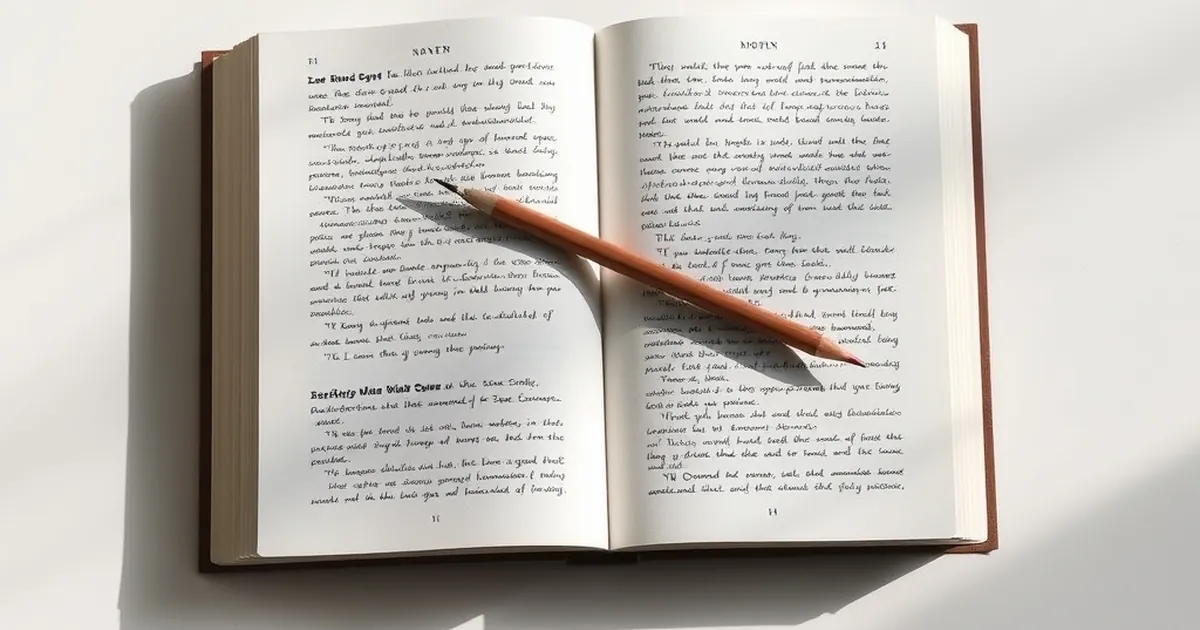
Somewhere between the pristine pages of a well-kept library book and the chaotic scribbles of a student’s cram session lies a forgotten cognitive tool: the margin. For two decades, I have been conducting an informal, longitudinal study on a specific method I call “interleaved marginalia,” and the results are beginning to challenge my assumptions about memory and comprehension. The question that has driven this personal research is deceptively simple: does the act of physically writing notes in the margins, specifically interleaved with the text over time, produce retention that outlasts the typical study cycle?
This is not a question about highlighting or underlining, which are passive acts of selection. It is about the active, generative process of dialogue with the page—a conversation that spans years, not just a single sitting. What I have found over these two decades is that the margin is not just a space for storage, but a temporal architecture for recall.
The Methodology of the Long Game
My experiment began in the early 2000s with a dense, non-fiction text on systems theory. I adopted a strict protocol: I would read a chapter, but only annotate the left-hand margin with questions and the right-hand margin with personal connections and counter-arguments. The critical rule was the interleaving—I could not revisit a note until I had read at least two subsequent chapters. This forced a temporal distance between the initial encoding and the retrieval attempt.
Over the years, this practice became a habit across my entire library. The texts I returned to most frequently—philosophy, history, and technical manuals—became palimpsests of my own intellectual evolution. When I return to a book after a hiatus of two years, or ten, I am not just reading the author’s argument; I am reading my past self’s reaction to it.
The First Pass: The Initial Dialogue
The initial annotation is crucial, but it is not about capturing everything. It is about capturing the tension in the text. I look for claims that feel slightly off, connections to other books I have read, or questions that the author seems to be dodging. This first layer is usually messy, full of arrows and circled words, but it serves as a high-fidelity snapshot of my initial cognitive state.
This step is akin to what cognitive scientists call the "generation effect." By generating a question or a critique rather than just reading a summary, the brain creates a stronger retrieval cue. The physical act of writing, as opposed to typing, also contributes to this, engaging motor memory in a way that digital notes often fail to replicate.
The Second Pass: The Temporal Interference
This is where the "interleaved" part of the title becomes critical. After a gap of months or years, I return to the book and read only my marginalia, not the main text. This is a brutal test. Often, the notes are cryptic. I find a question I wrote that now seems naive, or a connection that I no longer remember making.
The process of decoding my old notes is where the retention miracle occurs. I am forced to reconstruct the context of the original reading before I allow myself to look at the text again. This struggle to recall is the most effective form of retrieval practice known to cognitive psychology. If I can decipher the note, the memory trace is strengthened exponentially. If I cannot, I am left with a puzzle that compels me to re-read the chapter with far greater focus than I would have had otherwise.
The Retention Test: A Case Study in Failure and Success
Let me offer a concrete example from my own shelves. In 2008, I read a biography of a prominent physicist. In the margin next to a discussion of his early career, I wrote a single, arrogant word: "Nostalgia." I had no memory of writing this. When I found it in 2019, I was baffled.
The process of trying to understand that note was agonizing. I had to re-read the entire chapter to figure out what I had meant. It turned out I was critiquing the biographer’s romanticized portrayal of the scientist’s lab conditions. The word "Nostalgia" was a shorthand for a complex argument about historical revisionism. That single word, because it was meaningless without context, forced a deep re-engagement with the material. I now remember that specific critique far better than any other detail from the book.
The Failure of the Highlighter
This experience stands in stark contrast to my books that are filled with yellow highlighter. Those pages are a graveyard of intention. When I flip through them, I see a sea of yellow, but I have no idea why I thought those passages were important. The highlighter fails the retention test because it does not require any generative effort. It is a purely passive act that creates the illusion of competence, a phenomenon known as the "fluency illusion."
The highlighter is a tool for the first reading, but it is useless for the second. Interleaved marginalia, on the other hand, is designed specifically for the second, third, and twentieth reading. It turns the book from a static artifact into a dynamic testing device.
The Architecture of My Marginalia System
For those who wish to replicate this, the system does not require any specific brand of pen or notebook. It requires a set of rules that force retrieval.
The Right Margin: The Critique
The right margin is reserved for my contribution. This is where I argue with the author, draw parallels to unrelated fields, and record moments of personal insight. These notes are often longer and more reflective. They are the seeds of essays and ideas that have little to do with the book itself.
The Left Margin: The Socratic Prompt
The left margin is for questions that the text raises. These are not comprehension questions ("What is the main idea?"). They are disruptive questions ("How does this apply to a completely different cultural context?" or "What is the author not saying?"). When I return to the book, I try to answer these questions before reading the relevant text.
The Top Margin: The Index of Evolution
The top of the page is reserved for a date and a one-sentence summary of my current perspective on the page’s content. This creates a visible timeline of my own intellectual evolution. Seeing that I used to agree with a point I now find flawed is a humbling and powerful lesson in the fallibility of certainty.
The Practical Takeaway for a Digital Age
We live in an era of digital highlights and note-taking apps that sync across devices. These are wonderful for searchability, but they are terrible for the kind of deliberate forgetting that makes interleaved marginalia so effective. The friction of the physical page—the need to flip back, the inability to Ctrl+F—is a feature, not a bug.
My practical recommendation is not to abandon digital tools, but to use them differently. When you read an e-book, do not just highlight. Type a question in the margin that is deliberately cryptic, a note that you know will make no sense in six months. Then, schedule a "review" session where you are forbidden from searching the text for the answer. Force yourself to reconstruct the context from memory alone.
The goal of this two-decade test is not to become a better note-taker. It is to become a better thinker. The margin is a mirror, and interleaved marginalia is the art of looking into that mirror at odd intervals, seeing your past self, and realizing how much you have changed. The book is not a container for information; it is a tool for thinking, and the margins are where the thinking is made visible. The test is not about how much you remember, but about how much you are willing to forget in order to remember it better.