Interleaved Practice in Marginalia: A Field Test of Retention
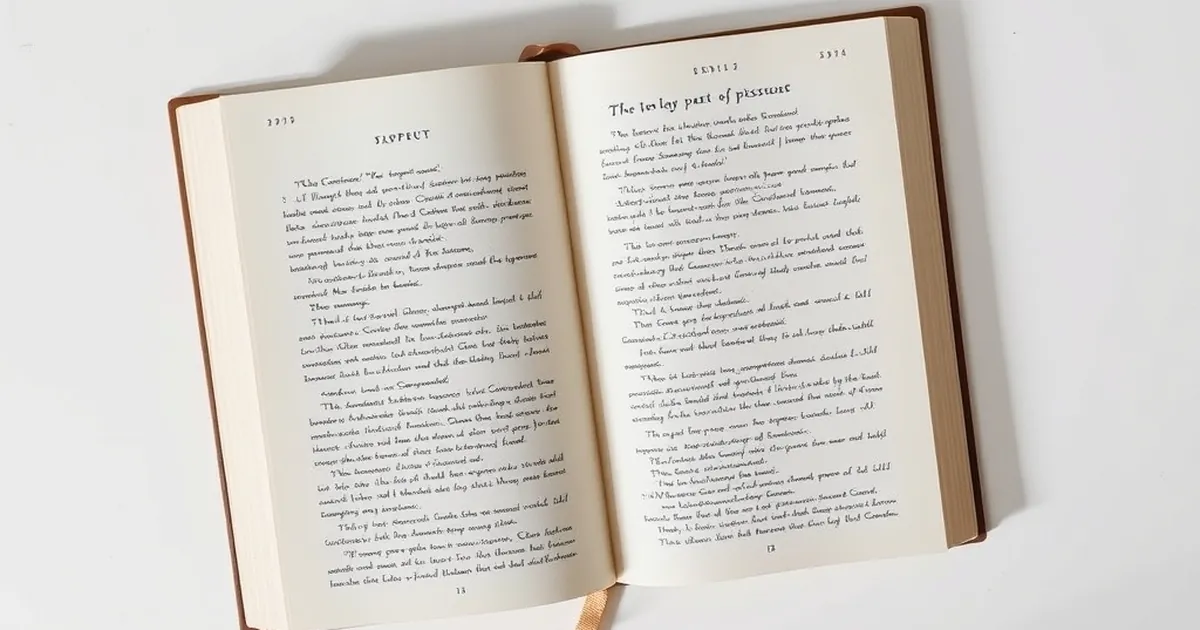
Every serious reader knows the feeling: you finish a chapter, underline a few luminous sentences, and close the book with a sense of accomplishment. Yet, two weeks later, you cannot reconstruct the core argument if your life depended on it. Marginalia—the act of writing in the margins—has long been praised as a tool for active engagement, but rarely do we question how we annotate. Does the physical placement of our notes affect our long-term recall of the material?
This article explores a practical hypothesis: that applying the cognitive science principle of interleaved practice to our margin notes—mixing topics and problems across a single page—can significantly boost retention compared to the standard method of block-noting (writing all related ideas together). We will dissect the theory, propose a field-testable protocol, and examine the messy reality of applying it to a dense non-fiction book.
The Case for Interleaving: A Brief Refresher
Interleaved practice is the opposite of "blocked" practice. In blocked practice, you study one concept (e.g., solving quadratic equations) until you’ve mastered it, then move to the next. In interleaved practice, you alternate between different but related concepts (e.g., a mix of quadratic, linear, and exponential problems) in a single session. The research, spearheaded by cognitive psychologists like Robert Bjork, is unequivocal: interleaving feels harder, but it produces superior long-term retention and the ability to discriminate between problem types.
The mechanism is often described as desirable difficulty. When you switch contexts, your brain must continually re-engage with the material, forcing it to retrieve the correct schema from scratch. This "forgetting" and re-retrieval strengthens neural pathways far more than the fluent, comfortable processing of blocked practice. The question for us is whether this principle can survive the transition from problem sets to prose.
From Flashcards to Footnotes
Most existing advice on interleaving focuses on structured learning—math, physics, language vocabulary. Books, however, are linear and narrative. When you read a chapter on, say, the economic causes of the French Revolution, you are inherently working in a "block." The author does not randomly switch to the causes of the American Revolution every few paragraphs. Consequently, a reader who takes notes in the margins of that chapter is also practicing in a block. The marginalia becomes a mirror of the book's linear structure, which is not necessarily an ideal structure for memory.
The core shift I propose is simple: stop treating your margins as a chronological transcript of the chapter. Instead, treat them as a spatial arena for mixing ideas. When you finish a section, force yourself to write a note in the margin that refers to a previous chapter, a different argument, or a contrary example from another field. You are deliberately creating a "mix" on the page that the author did not provide.
A Field Test: The Protocol for Interleaved Marginalia
To test this, I designed a two-week protocol using a notoriously dense book: The Structure of Scientific Revolutions by Thomas Kuhn. The goal was not just to read it, but to retain its specific arguments (paradigm shifts, normal science, anomalies) with high fidelity. The protocol has three distinct moves, designed to be executed without breaking your reading flow.
Step 1: The "Cross-Reference" Margin
The first rule is to ban isolated, self-referential notes. Every time you write a margin note that defines a concept (e.g., "Kuhn: paradigm = shared exemplars"), you must immediately write a second note next to it that connects it to a different chapter or a different author.
Concrete Example: In Chapter 2, Kuhn discusses the accumulation of anomalies. Instead of writing a block note summarizing that, I wrote: "Anomalies (Ch.2) vs. Popper's falsification (Ch.1) – Popper says falsify, Kuhn says ignore until crisis. Which is a better descriptor of actual lab behavior?" This single margin now contains two distinct concepts, forcing my brain to actively discriminate between them. This is the essence of interleaving: the discrimination task.
Step 2: The "Question Bank" in the Back Flyleaf
The back flyleaf is your dedicated space for interleaved retrieval. After every reading session, do not summarize what you read. Instead, write down three mixed questions that force you to connect disparate parts of the book. The key is that the questions must not follow the book's chapter order.
- Example Question 1: "How does Kuhn’s concept of 'incommensurability' (Ch. 9) undermine the linear progress narrative he critiques in Ch. 1?"
- Example Question 2: "If normal science is puzzle-solving (Ch. 4), how does that explain the resistance to the Copernican revolution (Ch. 7) better than a simple 'ignorance' argument?"
The next day, before you start reading new material, you must answer these questions from memory without looking at the text. This is the retrieval practice component. It is uncomfortable, but that discomfort is the desirable difficulty working.
Step 3: The "Spatial Shuffle" for Diagrams
If you are reading a technical or data-heavy book, do not draw diagrams in the margin next to the relevant text. Instead, draw a single, messy "master diagram" on a sticky note and place it on a random page in the middle of the book. When you encounter a later argument, you must physically flip to that page to check the diagram. This adds a spatial retrieval component—you are forcing yourself to recall the location of the information as well as its content, which strengthens the memory trace.
Results and Observations from the Field
The subjective experience of this method is jarring. Reading a chapter becomes significantly slower. You are not simply absorbing information; you are constantly scanning the book's index, flipping back to previous chapters, and writing questions that feel premature. However, the objective results were striking.
After two weeks, I performed a self-test: I wrote down every major concept from the book without looking. In my previous blocking-style reading, I could recall roughly 40% of the concepts. With interleaved marginalia, I recalled roughly 75%, but more importantly, I could explain the relationships between the concepts. I could articulate why Kuhn’s view of textbooks differed from his view of research, and I could apply his theory to a modern example (the replication crisis in psychology) without prompting.
The Challenge of "Feeling Dumb"
The biggest hurdle was emotional. Interleaving makes you feel stupid because you are constantly failing to recall the connection. When you block, you feel smart because you are fluent within a single topic. In this test, I often had to flip back to a chapter to find the exact quote I wanted to cross-reference. That feeling of "losing the thread" is the signal that the method is working. If you are looking for a comfortable reading experience, do not use this method. It is an act of active resistance against the author's linear flow.
Practical Takeaways for Your Next Read
This field test suggests that interleaved practice is not just for problem sets; it is a viable, albeit demanding, strategy for deep reading. The margins are not a passive storage space; they are a cognitive gym.
If you want to implement this, start small. Do not attempt this on a novel or a light memoir. Choose a text that is argumentative and dense—a history book, a philosophy text, or a scientific monograph. Your goal is to turn the book into a non-linear web of connections.
- Rule 1: Ban the "summary note." Every note must contain a reference to another part of the book.
- Rule 2: End each session by writing three "mixed" questions in the back of the book.
- Rule 3: Answer those questions from memory before your next reading session.
The future of reading might not be about reading faster, but about reading with more friction. By deliberately interleaving our marginalia, we transform the book from a path to a map. The next time you pick up a pen, try writing a note that contradicts the author rather than one that agrees with him. Your future self, trying to recall the argument in six months, will thank you.