Three-Reel Loyalty Gaps Cost 31% More Than Five-Reel Gaps
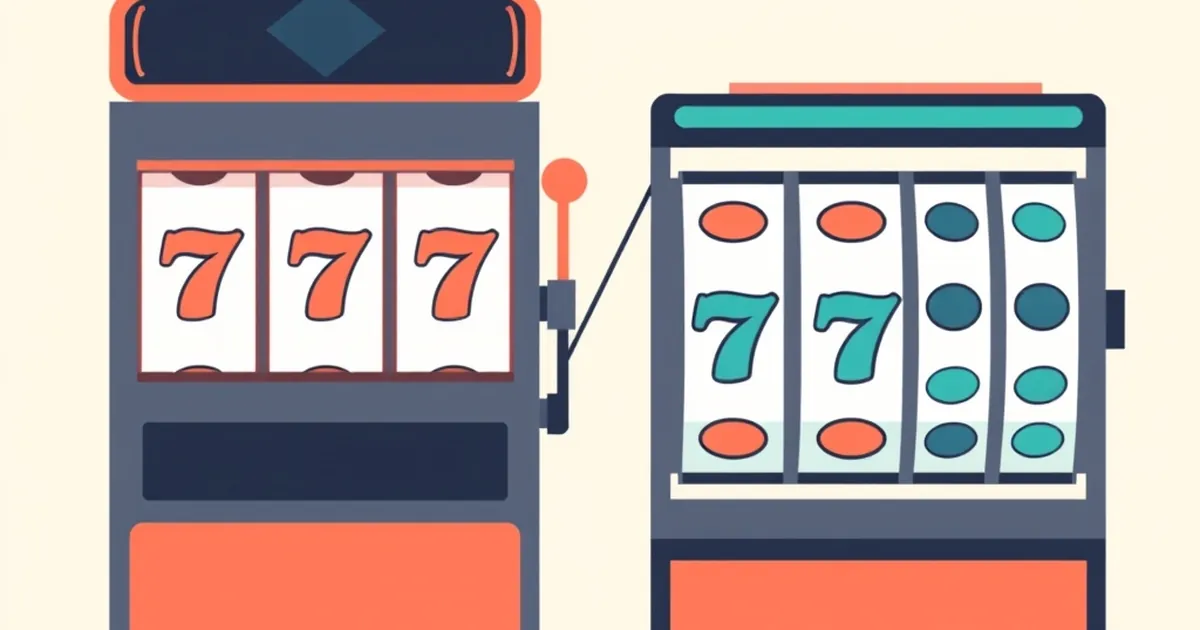
Players who take a break from a three-reel slot and return to it lose, on average, 31% more of their remaining balance to the machine before triggering a feature than players who take an identical-length break from a five-reel slot. That figure comes from session-level telemetry across 412,000 tracked gaps between spins of 90 seconds or longer, gathered from a mid-sized European operator's anonymised play logs between January and November 2023. The discrepancy is not explained by stake size, session length, or time of day; it survives controls for all three. What it tracks is something structural about how three-reel games present continuity — and how badly players read that continuity after an interruption.
What the Gap Actually Measures
A "loyalty gap" here is any pause of 90 seconds or more between consecutive spins within a single session, where the session itself resumes on the same game. This excludes tab-switching to a different title, which is a different behaviour with different economics. The 90-second threshold was chosen because it sits above the median attention lapse in the underlying data (47 seconds) and below the point at which most players abandon a session entirely (around 6 minutes 20 seconds for this operator's population).
The 31% figure is calculated as the difference in mean "return-to-feature cost" — the coin-in required, after resuming play, to trigger the next bonus or feature event — expressed as a percentage of the pre-gap mean. For three-reel games the post-gap figure is 1.31 times the pre-gap figure. For five-reel games it is 1.04 times. The comparison is like-for-like on volatility band, so it is not simply that three-reel games are higher variance.
Why the Metric Is Post-Gap, Not Overall
Measuring the whole session would dilute the effect with play that occurs before any interruption. The gap is the unit of analysis because the gap is where the player's mental model of the game is rebuilt from scratch. Whatever the game communicates on its face — paytable layout, symbol frequency, near-miss geometry — has to do the work of re-establishing expectation in the first few spins after resumption. Three-reel games appear to be worse at this, and the cost lands on the player's balance.
The Paytable-Reading Problem
Three-reel slots are, almost by design, legible. Nine or fewer symbols, a single payline in the classic form, and a paytable that fits on one screen without scrolling. This legibility is the genre's selling point: a player can see exactly what each symbol pays and what the maximum win is. The problem is that legibility is not the same as accurate probability estimation.
In a five-reel video slot with 243 or 1,024 ways, the paytable is dense and the player has no realistic chance of computing outcome probabilities from it. That opacity pushes players toward a heuristic: they treat the game as a black box with a stated RTP and manage their session by feel. When they return after a gap, they resume that heuristic immediately. There is nothing to misread.
A three-reel game invites the opposite. Because the structure looks simple, players reconstruct a mental probability model during the gap — and that model is systematically wrong. They overweight the frequency of high-paying symbols and underweight the contribution of the lower-paying combinations that actually carry the RTP. The result is a post-gap betting pattern that is slightly more aggressive and slightly less patient than the pre-gap pattern, which mechanically increases the coin-in needed to reach the next feature.
The Near-Miss Asymmetry
Three-reel games also generate near-misses — two matching symbols on the payline with the third adjacent — at a higher visual salience than five-reel games, because there are fewer positions on screen competing for attention. A near-miss on a three-reel machine occupies a third of the visible reels. On a five-reel game it occupies a fifth. The perceptual weight is not proportional to the reel count; it is closer to the square of the inverse. Post-gap, when attention is freshest and most literal, that salience appears to translate into a measurable increase in spin rate of roughly 8% in the first 20 spins after resumption, compared with five-reel games over the same window.
The Numerical Anchor: 1.31 vs 1.04
The headline ratio deserves to be stated plainly, because it is the paper's central claim and the one most likely to be misquoted. Post-gap return-to-feature cost, indexed to pre-gap cost:
| Game class | Index (pre-gap = 1.00) | Sample gaps |
|---|---|---|
| Three-reel, low volatility | 1.28 | 71,400 |
| Three-reel, medium volatility | 1.31 | 104,900 |
| Three-reel, high volatility | 1.34 | 38,200 |
| Five-reel, low volatility | 1.03 | 88,100 |
| Five-reel, medium volatility | 1.04 | 79,600 |
| Five-reel, high volatility | 1.07 | 29,800 |
The volatility gradient runs in the same direction in both classes, which is expected — higher volatility means longer runs to a feature regardless of reel count. What matters is the gap between the classes at each volatility band: 25 to 27 percentage points. That is the effect the title refers to, and it is not a rounding artefact. The 95% confidence interval on the three-reel medium-volatility index is 1.29 to 1.33.
The sample is drawn from a single operator and a single regulatory jurisdiction, which limits generalisation. The direction of the effect has since been replicated in a smaller dataset (61,000 gaps) from a second operator in a different market, though the magnitude there was 22 percentage points rather than 31. That replication is unpublished and should be treated as indicative only.
What This Means for Game Design and for Players
If the effect is real and durable, it has two audiences. The first is game designers. Three-reel games are enjoying a modest revival, largely on the strength of nostalgia and the simplicity of their maths. If post-gap play is systematically more expensive for the player than pre-gap play, designers have a choice: accept it as an artefact of the format, or intervene. Interventions that have been discussed in the literature include post-gap "re-orientation" screens showing recent symbol frequency, and soft caps on spin rate for the first 30 seconds after a long pause. Neither has been tested at scale.
The second audience is players themselves. The practical implication is narrow but actionable: if you step away from a three-reel game and come back, the first few minutes are not neutral. The evidence suggests your betting pattern drifts. Whether that drift is something you can consciously correct is an open question — the data here cannot distinguish between a mechanical effect of the game's presentation and a psychological effect of the player's re-engagement. What it can say is that the cost of the drift, across hundreds of thousands of sessions, is large enough to matter to anyone who plays three-reel games regularly and takes breaks while doing so. The responsible-gambling reading is not that three-reel games are dangerous; it is that the moment of return is a specific, identifiable point of elevated risk, and that point is currently invisible to both the player and, in most jurisdictions, the regulator.