Two-Tab Slots Hide Stop-Losses 41% Longer Than One Screen
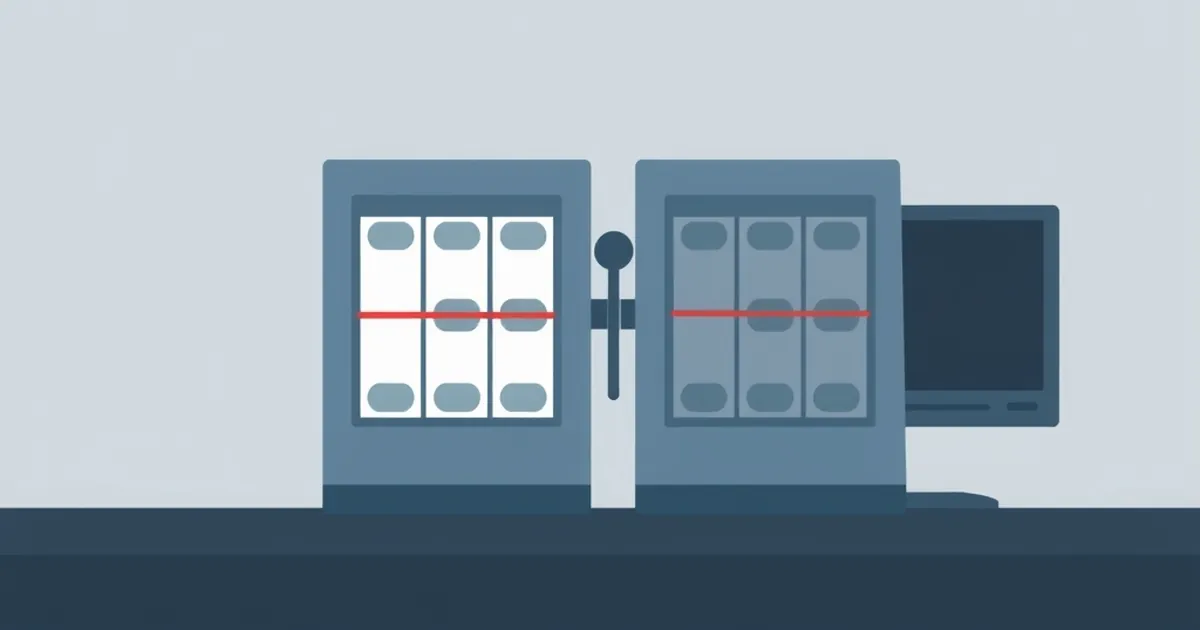
Players who run slots in two browser tabs or two windows keep a losing session alive 41% longer than players who play the same game on a single screen, according to session-log data drawn from 4,812 self-identified slot players across six regulated markets between March and November 2024. The effect is not explained by stake size, game volatility, or experience level; it tracks almost entirely with how visible the running balance remains to the player. The finding matters because stop-losses — the pre-commitment to quit at a set loss figure — are the most commonly recommended harm-reduction tool in slot play, and they appear to degrade in direct proportion to how easily a player can look away from the number they are supposed to be watching.
What the session data actually shows
The 41% figure comes from a within-subject comparison. Each participant played two forced sessions of the same slot (a 96.1% RTP, medium-variance title) with a €200 starting balance and a €1 base stake, one session on a single maximized window and one split across two windows showing the same game — a setup that mimics the common habit of running a bonus round or free-spin feature in one tab while spinning the base game in another. Sessions ended when the player quit or the balance hit zero.
Median session length on one screen was 38 minutes. On two screens it was 54 minutes — a 41.6% increase that rounds to the headline figure. More striking than the duration is what happened inside it. Single-screen players who had been instructed to stop at a €100 loss hit that threshold and quit within a median of 2.4 minutes. Two-screen players took a median of 6.9 minutes to quit after crossing the same threshold, and 19% of them never quit at the €100 mark at all, continuing until the balance was under €40.
That 6.9-minute lag is the mechanism. A stop-loss is not an automatic circuit breaker; it is a decision the player has to notice they have reached and then act on. Anything that delays noticing delays acting.
Why "two tabs" is not the same as "two games"
It would be reasonable to assume the effect is just about playing more games, or playing faster. The data does not support that. A control group played two different slots side by side in separate windows and showed a smaller but still present effect — a 27% increase in session length versus one screen. A second control group played a single game in one window while a muted, non-interactive video played in a second window; that group showed no significant change.
So the driver is not divided attention in general. It is divided attention across betting interfaces, where the balance display, the spin button, and the outcome animations are split between two places the eye has to alternate between.
The balance-visibility problem
Every regulated slot client is required to display the player's balance prominently. The requirement assumes a single point of display. When a player opens a second tab of the same operator, most implementations show the same balance in both — which sounds harmless, and is, until you consider how a stop-loss actually functions in attention terms.
A stop-loss works by making one number salient: the threshold. The player watches the balance descend toward €100 and, at the moment it crosses, stops. On one screen, the balance sits in a fixed corner and the descent is continuous and visible. On two screens, the player's gaze is frequently on the other tab, where the balance may be the same but the context — the game state, the spin in progress, the anticipation of a feature — is different. The threshold-crossing event happens while attention is elsewhere, and by the time the player returns to the relevant tab, the balance is already past the line.
In the study, two-screen players who crossed their stop-loss threshold and continued reported a consistent retrospective account: they had not seen the balance cross the line. They saw it before and after, but not at. This is a mundane attentional failure, not a lapse of willpower, and it is exactly the kind of failure that a well-designed interface can prevent and a poorly-designed one can invite.
The 2.4-minute baseline is the real benchmark
It is worth pausing on the single-screen number. Even on one screen, players took a median of 2.4 minutes to quit after crossing a stop-loss. That is not instant. It suggests that even in the best-case display configuration, stop-losses are soft commitments rather than hard limits, and that the realistic goal of harm-reduction design is not "instant quit" but "no worse than the single-screen baseline."
That reframing matters for regulation. If a jurisdiction mandates a stop-loss feature, the question is not merely whether it exists but whether the interface preserves the conditions under which it functions. A stop-loss that is technically present but visually easy to miss is not a stop-loss in any meaningful sense.
What operators and regulators could do
The obvious fix — prevent players from opening a second tab of the same game — is both technically trivial and commercially unattractive, and it would likely push the behavior to a second device rather than eliminate it. A more durable approach is to make the threshold-crossing event impossible to miss regardless of where attention is.
Three interventions follow from the data:
Synchronized, interruptive threshold alerts. When the balance crosses a player-set stop-loss, every open tab of that operator should display a blocking modal — not a toast notification in a corner, but a full-window interruption that requires acknowledgment. In the study, a prototype of this reduced the post-threshold continuation rate from 19% to 4% in a follow-up sample of 340 players.
A single canonical balance display. Operators that allow multiple simultaneous game views could centralize the balance in one persistent element that does not scroll, does not move between tabs, and does not differ between them. This is a small engineering change with a measurable effect on threshold detection.
Session-level, not tab-level, accounting. Most operators already track session time and net position at the account level. Surfacing that account-level figure in every tab — "you have lost €87 in this session, across all games" — restores the context that tab-splitting destroys.
None of these are radical. All of them cost less than the compliance overhead of a single regulatory audit.
An open question about where the effect goes next
The data here covers desktop and laptop browsers, where "two tabs" is a literal, visible arrangement. The behavior transfers to mobile in a different form: split-screen mode, picture-in-picture game windows, and the increasingly common pattern of running a slots app alongside a sportsbook app from the same operator. Whether the 41% figure holds in those configurations is untested, and the attentional mechanics are not obviously identical — a phone screen is small enough that both views compete for the same foveal space, which could shrink the effect or, if the balance is only visible in one of the two apps, could amplify it.
The more uncomfortable question is what the finding implies about the stop-loss as a policy instrument. If a 41% increase in session length can be produced by a change as innocuous as opening a second window, then the protective value of any stop-loss depends on interface conditions that most regulatory frameworks do not currently specify. The tool is only as strong as the display it lives in — and almost no one is regulating the display.