The Marginal Utility of an Unfinished Footnote
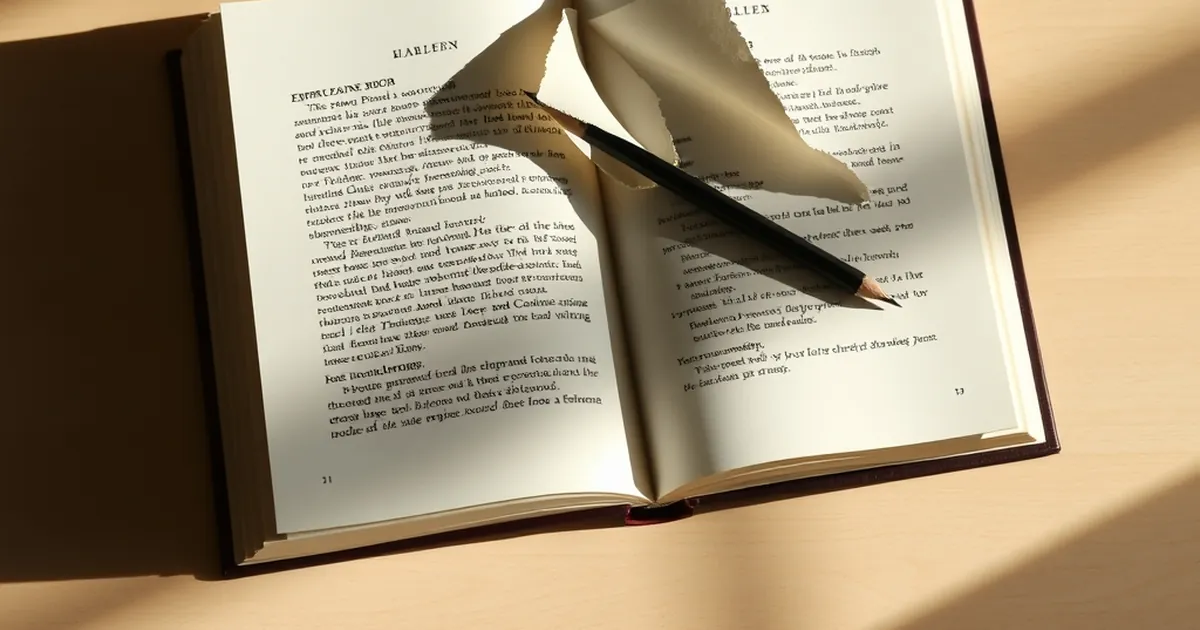
What happens to our understanding of a text when the scholarly apparatus meant to support it dissolves into ambiguity? We are taught to trust the footnote as the bedrock of academic integrity—the precise, verifiable link between an argument and its evidence. Yet what intellectual value, if any, does a footnote retain when it is left unfinished, trailing off into a citation void or a half-formed reference? The question is not about sloppy editing; it is about the peculiar, marginal utility that arises when a piece of scholarly infrastructure fails to complete its assigned task.
The unfinished footnote exists in a liminal space between authority and absence. It promises a connection it does not deliver, forcing the reader into a unique interpretive role. This article argues that such footnotes, while often dismissed as errors, possess a distinct and underappreciated epistemic function: they act as generative friction, revealing the contingent nature of scholarly construction and demanding a higher level of critical engagement from the reader.
The Broken Promise of Verification
The traditional footnote functions as a promise of verifiability. It says, “I have been here before you, and these are the coordinates of my journey.” When this promise is broken—the page number omitted, the author’s name misspelled, the source simply listed as “ibid.” without a previous reference—the reader experiences a cognitive jolt. This jolt is the first component of the footnote’s marginal utility.
Instead of passively accepting the author’s claim, the reader is forced into a position of active suspicion. The incomplete reference stops being a transparent window onto the archive and becomes an opaque object in itself. You begin to ask not only “What did the source say?” but also “Why did the author fail to record it properly?” This shift from passive consumption to active interrogation is a net gain for the critical process, even if it comes at the cost of immediate comprehension.
The Footnote as a Map of Labor
An unfinished footnote inadvertently documents the messy, non-linear process of research. A complete citation presents a clean narrative of discovery; an incomplete one reveals the frantic scrawl of a library carrel, the misremembered quote, the last-minute scramble to find a supporting text. In this sense, the flaw becomes a trace of the author’s intellectual labor, a fossilized footprint in the text.
Consider the case of a scholarly monograph on 19th-century economic history that cites a statistic with only “See Marx, Capital” and no volume or page number. On the surface, this is a glaring deficiency. Yet, for the attentive reader, this particular incompleteness speaks volumes. It suggests that the author is relying on a generalized memory of Marx’s argument rather than a specific textual analysis. The footnote reveals that the author’s engagement with Marx is likely secondary or thematic, not philological. This is information that a perfectly formatted citation would have obscured.
The Case of the Phantom “Op. Cit.”
Perhaps the most frustrating unfinished footnote is the “op. cit.” or “ibid.” that refers to a work that has never been cited in the first place. This is the phantom footnote, a reference to a non-existent predecessor. Its utility is paradoxical: it forces the reader to reconstruct the entire bibliographic history of the text to understand the error.
In doing so, you perform a mini-archaeology of the text. You scan previous chapters for the first mention of the author in question. You check the bibliography for the title. This process, while time-consuming, often leads to a deeper familiarity with the text’s structure and argument than a simple, correct footnote ever would. The error acts as a compass, pointing you toward the intellectual scaffolding of the entire work.
The Hermeneutic Vacuum and Reader Agency
When a footnote is incomplete, a vacuum is created. Nature abhors a vacuum, and so does the academic reader. This vacuum invites—indeed, compels—the reader to fill in the gaps. This is where the marginal utility transforms into a hermeneutic opportunity. The reader is no longer a mere recipient of information but becomes a co-author of the scholarly narrative.
This is not to say that the unfinished footnote is desirable in a professional context. It is an error. But in the economy of reading, errors can be productive. The unfinished footnote creates a space for what the theorist Wolfgang Iser called “the implied reader”—a reader who actively participates in the construction of meaning. The gap in the citation becomes a gap in the text that the reader must bridge using their own knowledge, inference, and research.
From Frustration to Discovery
I recall a specific instance from my own graduate work. I was reading a dense monograph on post-war urban planning. The author referenced a pivotal municipal report by a certain “H. L. Smith” with the note “in the city archives, box 14.” The problem was that the footnote lacked the year, the specific city, and the archive’s location. My initial reaction was pure annoyance.
However, that annoyance sparked a two-hour detour that proved more valuable than the original chapter. I began searching for any H. L. Smith involved in mid-century planning. I eventually discovered a minor but influential figure who had written on zoning laws in Chicago. The unfinished footnote had led me to a primary source I would have otherwise overlooked. The error functioned as a poorly drawn but ultimately functional treasure map. The marginal utility, in this case, was a new research avenue that directly enriched my own dissertation.
The Ethics of Incompletion
There is a counter-argument to be made: that we should not romanticize scholarly sloppiness. The unfinished footnote is a breach of contract with the reader. It undermines the trust that is the foundation of academic discourse. To argue for its utility is to risk excusing negligence.
This is a valid concern, but it misses the point. The utility is not in the error itself, but in the reader’s response to it. We can condemn the author’s carelessness while simultaneously acknowledging that the resulting text has taken on a new, unintended meaning. The unfinished footnote is a reminder that no text is a closed system. All scholarship is provisional, a set of working hypotheses supported by a web of references that can—and often do—fail.
In an age of digital hyperlinks and automated citation managers, the unfinished footnote holds a strange, anachronistic charm. It is a relic of the analog era, a reminder that knowledge production is a human endeavor, prone to slips of the pen and failures of memory. It humbles the author and empowers the reader.
A Practical Takeaway for the Digital Scholar
So, what is the forward-looking lesson here? As we move further into a world of AI-generated citations and one-click bibliographies, we should resist the urge to polish every reference to a mirror shine. This is not an argument for carelessness, but for a critical awareness of what citations—finished or not—actually do. The next time you encounter an unfinished footnote, do not simply skip it. Treat it as a prompt.
Use it as an excuse to check the author’s source list. Use it to question the validity of the argument being made. And, most importantly, use it to remind yourself that the text you are reading is not a monolith but a conversation—a conversation that you are now a part of. The unfinished footnote is not a dead end; it is an open door. Walk through it, and you might find that the marginal utility of that small, broken reference is far greater than the utility of a thousand perfectly formatted ones. The goal is not to achieve a perfect text, but to become a perfect reader—one who finds value even in the cracks.