Why Marginalia Outperforms Digital Notes for Deep Recall
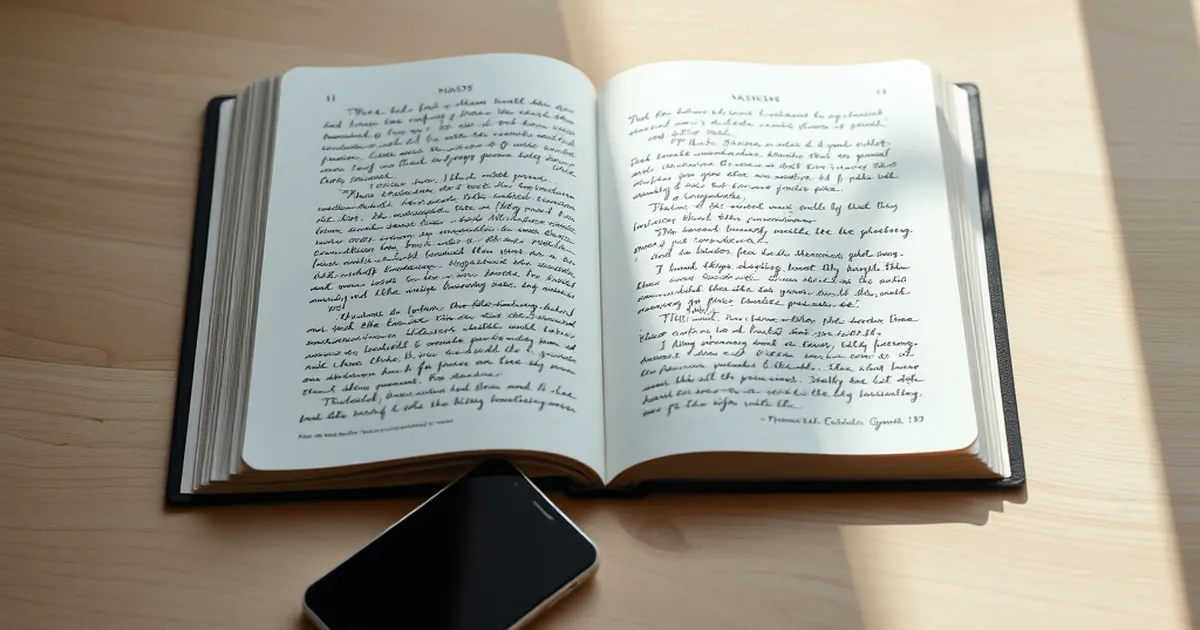
The question of whether we actually remember what we read is rarely answered by the volume of highlights we accumulate. We have traded the physical intimacy of the book for the infinite scroll of the note-taking app, yet our retention often feels worse, not better. The core issue is not about storage capacity or searchability; it is about the cognitive mechanics of encoding. This article argues that the deliberate, physical act of writing in the margins of a book creates a superior memory trace than the disembodied act of copying digital text, primarily because it forces a synchronous, spatial, and emotional engagement that digital tools often bypass.
The Illusion of Digital Capture
The primary allure of digital note-taking is its promise of perfect recall through organization. We believe that if we copy a passage into a second brain, we have learned it. This is a cognitive fallacy. Digital tools excel at the storage of information, but they are notoriously poor at facilitating the retrieval of that information from your own mind.
When you type a note, the process is often a passive transcription. Your fingers move, but your brain is not necessarily reconstructing the argument. The ease of copy-paste further exacerbates this; you can extract a quote without ever processing its syntactic weight or semantic implications. The result is a library of orphaned ideas—perfectly searchable, but fundamentally disconnected from your neural network.
Digital notes are typically stored in a linear, chronological feed or a series of nested folders. This structure is logical but a-temporal. It removes the text from its original context, stripping away the visual and physical cues that your brain uses to anchor memories. You are left with the "what" of the text, but you have lost the "where" and the "how" of your encounter with it.
The Physical Argument: Spatial Anchoring
The book is a physical object, and your brain is wired to map physical space. When you read a physical book, you create a mental map of the text. You remember that a key argument was on the top right of the left-hand page, near a specific diagram. This is known as spatial contextual memory.
Marginalia exploits this biological predisposition. Writing in the margin anchors your thought to a specific location on a specific page. When you later attempt to recall the content, your brain does not just search for the semantic meaning; it retrieves the image of the page, the position of the ink, and the physical weight of the book in your hand. This multi-sensory retrieval path is significantly more robust than the single path offered by a text file.
The Kinesthetic Feedback Loop
The physical act of writing is slower than typing, and this slowness is a feature, not a bug. The motor cortex is activated when you form letters by hand, creating a procedural memory that is tied to the cognitive content. This is the "generation effect"—the process of producing information (rather than passively receiving it) enhances memory.
Furthermore, the pressure of the pen on the paper provides tactile feedback that is absent from a keyboard. This sensory input signals to your brain that this moment is significant. It is a physical annotation of time, marking the exact millisecond a thought crystallized in your mind. Digital typing, by contrast, is a uniform, monotonous motor action that does not differentiate between writing a grocery list and transcribing a philosophical treatise.
The Cognitive Argument: Dialogue Over Monologue
Digital note-taking often encourages a "collector" mindset, where the goal is to hoard information. Marginalia, however, forces a "critic" mindset. The margins are too small for lengthy transcription; they demand compression and synthesis. You cannot copy the text into the margin; you must react to it.
This reaction is the foundation of deep processing. When you write "This contradicts Smith's theory!" or "Does this apply to the 21st century?" in the margin, you are engaging in a dialogue with the author. You are testing the thesis against your existing knowledge base. This active interrogation is what psychologists call "elaborative rehearsal," and it is the single most effective way to move information from short-term to long-term memory.
The Power of the Personal Index
Digital tools offer tags and links, but marginalia offers a personal index of emotion. Your annotations are not neutral keywords; they are emotional markers. A "?" in the margin indicates confusion, a "!" indicates surprise, and a "No" indicates rejection. These emotional tags are powerful retrieval cues.
When you revisit a book, you are not just re-reading the author's words; you are re-reading your past self. You see the evolution of your thoughts. You see the arguments you once found convincing and the ones you now reject. This creates a layered, palimpsest-like reading experience that a digital document, which can be edited and cleaned, simply cannot replicate. The messiness of the margin is a record of your intellectual struggle, and that struggle is what cements the knowledge.
A Concrete Example: The Case of the Disappearing Quote
I recall a graduate seminar where a colleague swore by her Notion database. She had meticulously tagged every article we read, categorizing them by theme and author. During the final exam, she could recall the names of the theorists and the titles of the papers, but when asked to synthesize the arguments, she drew a blank. She had the metadata, but she had lost the data.
In contrast, I had a dog-eared copy of Benedict Anderson’s Imagined Communities covered in frantic pencil scribbles. I had written "This is the key to nationalism" next to a specific passage about print-capitalism. I did not remember the page number, but I remembered the corner of the page where I had written that. I remembered the frustration I felt in trying to articulate the concept. During the exam, I could visualize the page, see my handwriting, and reconstruct the entire argument from that single spatial anchor. The difference was not intelligence; it was the depth of the encoding process.
The Counterpoint: When Digital Wins
It would be disingenuous to claim that marginalia is superior in all contexts. For the storage of complex research data—statistics, citations, and cross-references—digital systems are indispensable. The ability to full-text search across hundreds of PDFs is a modern miracle that no physical library can match.
The key distinction lies in the purpose of the note. If you are writing a literature review and need to retrieve specific citations quickly, digital is your tool. If you are reading to understand a complex concept or to build a mental model of an argument, physical marginalia is the superior choice. The former is about retrieval of the source; the latter is about retrieval of the idea.
A Practical Takeaway: The Hybrid Approach
The goal is not to discard your digital tools, but to demote them. They should be the final archive, not the initial processing unit. The most effective reading strategy is a two-stage process.
First, read the physical book with a pen in hand. Do not worry about organization. Scribble, question, argue, and underline. Treat the margins as a private conversation with the author. This is the stage where deep recall is built. Second, only after you have finished the chapter, type your marginalia into your digital system. This act of transcription is a second exposure to the content, but this time, you are synthesizing your own thoughts, not the author's text.
This method ensures that the digital note is a product of your cognition, not a copy of the author's. It forces you to paraphrase your own scribbles, which is a higher-order thinking skill. By the time you have typed your margin notes, you will find that you rarely need to look at them again—because the act of writing them twice has already embedded the knowledge in your mind. The digital file becomes a safety net, not a crutch.